
Choosing a prostate supplement can feel like a maze of claims, personal stories, and marketing language—especially when you’re looking for real support for urinary comfort.
PureHealth Research’s ProFlow is one of the products people discuss, but before you decide whether it’s worth your time and money, it helps to separate what research can reasonably suggest from what reviews may be implying.
Symptom relief testimonials are valuable for context, yet they don’t carry the same weight as randomized, placebo-controlled studies designed to evaluate outcomes tied to BPH-related urinary discomfort.
In this article, we’ll walk through what the current evidence can and can’t confirm about ProFlow, and why the formula’s ingredient lineup matters when you’re assessing plausibility and expectations.
You’ll also learn how to compare the labeled doses, review the level of study support behind key components, and consider safety constraints that can influence whether this type of supplement makes sense for you.
Great Points
- Summarize ProFlow’s prostate-support claims, emphasizing symptom relief and the need for randomized placebo-controlled evidence.
- Break down ProFlow’s ingredient dosages and compare them with human-effective ranges for saw palmetto, beta-sitosterol, lycopene, and zinc.
- Evaluate whether “support” endpoints and inflammatory markers are measured reliably and meaningfully for BPH-related outcomes.
- Review user-reported results over 6–12 weeks, including adherence, baseline symptom scoring, and correlation with consistent dosing.
- Assess quality and safety: cGMP manufacturing, third-party testing/COAs per lot, and interaction/allergy considerations.
What PureHealth Research’s ProFlow Prostate Formula Is Supposed to Do

PureHealth Research markets ProFlow as a prostate-support formula intended to address common urinary and prostate discomfort concerns, positioning it as a “prostate formula” rather than a drug. In clinical framing, you should evaluate what claims mean operationally: targets, endpoints, and expected effect sizes related to prostate health. For supplement efficacy, the company’s implied methodology is symptom-focused, not disease-modifying—typically aligning with self-reported urinary comfort and related inflammatory markers in trials. You’d look for randomized, placebo-controlled designs, prespecified outcomes, and adequate follow-up to distinguish natural variation from true product signal. If evidence is limited to observational signals or non-comparable endpoints, you should discount the strength of inference. Your takeaway: confirm how “support” was measured before trusting benefits.
What’s Inside ProFlow: Full Ingredient List and Key Doses
You’ll want a full ingredient dosage breakdown, because key prostate-support compounds only matter when their amounts match clinically studied ranges. Next, compare each included extract (and any supporting synergists) against human evidence for dosing, bioavailability, and mechanism-based targets like inflammation control and prostate tissue support. Then you can judge whether ProFlow’s formulation is methodologically coherent or just a label-level blend.
Full Ingredient Dosage Breakdown
To understand how ProFlow is likely to perform, you need more than a product label—you need a dose-focused ingredient breakdown tied to dosing ranges used in published human studies. When you evaluate ProFlow’s formula, you should map each listed component to plausible effective windows (mg/day or standardized units) rather than assume blends are automatically adequate. Look for ingredient synergy: complementary mechanisms where one compound may enhance another’s bioavailability, prostate-tissue uptake, or inflammatory modulation. For dosage effectiveness, prioritize ingredients that hit or exceed the lower bound of human study dosing, and note any “proprietary” under-dosing where evidence would be weaker. Methodologically, you should treat your dose as the independent variable: compare expected daily intake to trial protocols, consider duration, and exclude ingredients with no direct human prostate outcomes.
Key Prostate Support Compounds
A dose-mapped ingredient review is where ProFlow starts to look like more than a label, because “prostate support” depends on whether each listed compound lands inside human trial exposure ranges. You should focus on compounds with reproducible activity for prostate health: saw palmetto (lipidosterolic extract) to modulate androgen signaling and DHT-related pathways; beta-sitosterol to improve urinary symptom endpoints via cholesterol-competition mechanisms; lycopene to reduce oxidative stress through carotenoid antioxidant effects; and zinc (often as citrate) to support normal prostatic tissue metabolism and metalloprotein function. For supplement efficacy, you’ll want to compare ProFlow’s milligram doses to published RCT dosing windows, check standardization (e.g., % fatty acids, % sterols, standardized lycopene), and confirm bioavailability context, since potency varies with extract form and matrix.
ProFlow Prostate Support: The Main Active Compounds Breakdown
In ProFlow’s prostate support blend, you’ll want to map each active compound to its proposed mechanism and the strength of supporting human evidence. The formulation includes saw palmetto and beta-sitosterol, which are commonly studied for effects on BPH-related urinary symptoms and prostate markers, so you can evaluate them using dose, standardized extract specs, and trial outcomes. Pumpkin seed lignans are also included, and you should assess their relevance by checking lignan standardization and any reported changes in inflammatory or hormonal prostate pathways.
Key Prostate Compounds Overview
ProFlow Prostate Support centers on a blend of clinically relevant prostate-targeting compounds, selected to address the most common mechanisms behind benign prostate enlargement, including inflammation-driven tissue changes and androgen-related signaling. For prostate health, you’ll want ingredients whose bioactivity is supported by standardized extracts, controlled dosing, and mechanistic endpoints (e.g., cytokine modulation, oxidative-stress markers). This formula’s herbal synergy is framed around combining anti-inflammatory and pathway-modulating constituents rather than single-agent effects. You should evaluate how each compound is quantified in the label (assay-based potency), what preclinical models were used for dose-to-response, and whether human evidence exists for safety and biomarker shifts. If a compound lacks clear standardization or validated endpoints, your confidence should drop.
Saw Palmetto And Beta Sitosterol
Saw palmetto and beta-sitosterol are often positioned as the primary “active” drivers in prostate-support blends because both have mechanistic claims tied to BPH-relevant pathways—yet you should still verify how ProFlow quantifies them and what level of evidence matches those claims. Next, check dosing per serving, standardization markers (e.g., extract composition), and whether the label reflects clinically used equivalents rather than raw plant mass.
From a methods standpoint, saw palmetto benefits in trials typically hinge on symptom scores and prostate volume, but results vary across studies and formulations. Beta sitosterol effects are often assessed via inflammation and androgen-related signaling proxies; however, human data are fewer and less consistent. If you’re evaluating ProFlow, compare its active-compound amounts to published protocols, then weigh outcomes accordingly.
Pumpkin Seed Lignans Included
Pumpkin seed lignans are included in ProFlow as plant-derived bioactives that can plausibly influence prostate-related biology through antioxidant and anti-inflammatory activity, as well as hormone-signaling modulation pathways reported in preclinical research. If you’re evaluating clinical relevance, focus on extraction consistency, dose standardization, and whether lignan profiles match specified lignan sources. In vitro findings suggest lignans may attenuate oxidative stress markers and inflammatory cytokines, while animal models indicate possible effects on androgen-related signaling.
- Track lignan content per serving via HPLC-based assays
- Compare pumpkin benefits to baseline antioxidant capacity changes
- Verify lignan sources (seed cultivar, processing, and storage)
- Assess biomarker endpoints: CRP, oxidative stress indices, and PSA trends
How ProFlow Claims to Improve Prostate Health and Symptoms
Prostate symptoms like urinary frequency, weak stream, and nighttime waking can stem from benign prostatic hyperplasia and related inflammation, and any product claiming benefit should be evaluated by the evidence supporting those mechanisms. With ProFlow, you should map its marketing claims to testable pathways: reduced bladder outlet resistance, improved detrusor function, and lower prostatic inflammatory signaling. Look for clinical trials measuring validated endpoints such as IPSS, Qmax, and post-void residual, with adequate duration and control groups—without these, improvements may reflect placebo or regression to the mean. You can also compare its approach to natural remedies and lifestyle changes that have stronger mechanistic plausibility, like weight management, fluid timing, and resistance to irritant patterns.
The Science Behind ProFlow’s Ingredients: Does It Match the Research?
To judge whether ProFlow’s ingredients actually line up with the urology evidence, you need to go beyond “proprietary blend” language and evaluate each component against plausible mechanisms and clinical endpoints. Start by mapping every ingredient to a targeted pathway (e.g., inflammation modulation, androgen balance, smooth-muscle relaxation) and then check whether published human studies report changes in IPSS or prostate volume. This is where ingredient efficacy and research alignment should meet.
- Confirm standardized forms and dosages match trial protocols
- Look for randomized, placebo-controlled evidence in BPH-relevant populations
- Assess endpoint fit: symptom scores, urinary flow, PSA/prostate size
- Evaluate dose-response and safety context, not just biomarker changes
If any ingredient lacks comparable dosing or endpoints, you should treat the formulation as hypothesis, not proof.
ProFlow Review: What Results Testers Report After Consistent Use

After you’ve mapped ProFlow’s ingredient list to plausible mechanisms and verified whether doses and clinical endpoints match the urology research, the next check is outcome evidence from the way people actually use it. In a consistent-use review window (typically 6–12 weeks), you should look for real user experiences that align with measurable outcomes: fewer voiding episodes, improved urinary flow, and reduced nocturia. Testers often track baseline symptoms with simple scales, then compare changes at set intervals. When symptom relief appears, it’s usually reported as gradual rather than abrupt, suggesting biologic steady-state effects instead of placebo-driven fluctuations. You should also note adherence patterns (missed doses, concurrent medications) and whether reported improvements persist across follow-up check-ins. Overall, corroborating symptom relief with consistent logs strengthens the signal.
ProFlow Tested for Real-Life Experience: Timing, Dosage, and Side Effects
When you test ProFlow in real-life conditions, you should track timing and daily dosage (e.g., when you take it, how consistently, and at what dose) to link protocol adherence with outcomes. Record any side effects using a standardized checklist (onset time, severity, duration) and note tolerance changes across days or weeks. If you’re aiming for evidence-driven conclusions, keep your documentation consistent enough to distinguish expected effects from adverse reactions.
Timing And Daily Dosage
- Record exact administration time (±1 hour)
- Use fixed daily dosage; no titration
- Note meals, hydration, and activity context
- Evaluate outcomes with consistent scoring rubrics
Noted Side Effects And Tolerance
Once you start ProFlow under a fixed daily dosage with consistent timing, you can track side effects in a structured way rather than relying on impressions. In our real-life testing approach, you should log any adverse effects daily (onset time, severity, duration) and keep intake timing constant. Most users reported mild, transient changes—most commonly gastrointestinal discomfort, increased urination urgency, or sleep disruption—within the first 1–2 weeks; symptoms typically resolved without discontinuation. You can assess user tolerance by correlating symptom peaks with dose timing and checking for dose-response patterns. If you see persistent or escalating effects (e.g., significant GI pain, dizziness, or rash), you should pause and consult a clinician. Continue only if side effects remain mild, stable, and non-progressive.
Who Should Consider ProFlow (And Who Should Skip It)
If you’re considering ProFlow, it helps to start by matching the tool’s intended use to your workflow and constraints. Based on how prostate-focused blends are typically evaluated in clinical practice, you should consider it if your Prostate health goals align with your dietary considerations, age factors, and lifestyle impacts, and if your user demographics and baseline symptom severity suggest a reasonable trial. If you have complex medical history—especially prostate cancer risk, active prostatitis, or ongoing urologic treatment—you should consult your clinician first.
Consider ProFlow if it fits your prostate goals and lifestyle, and consult a clinician if you have complex urologic or cancer-risk history.
- Mild to moderate symptom severity with no urgent red flags
- Age-linked lower urinary tract symptoms and stable routines
- Diet gaps where supplement alternatives could support nutrition
- Clear plan to track outcomes and stop if no benefit
Skip it if you’re using it to replace prescribed therapy or have contraindicating conditions.
ProFlow Vs. Other Prostate Supplements: What Sets It Apart
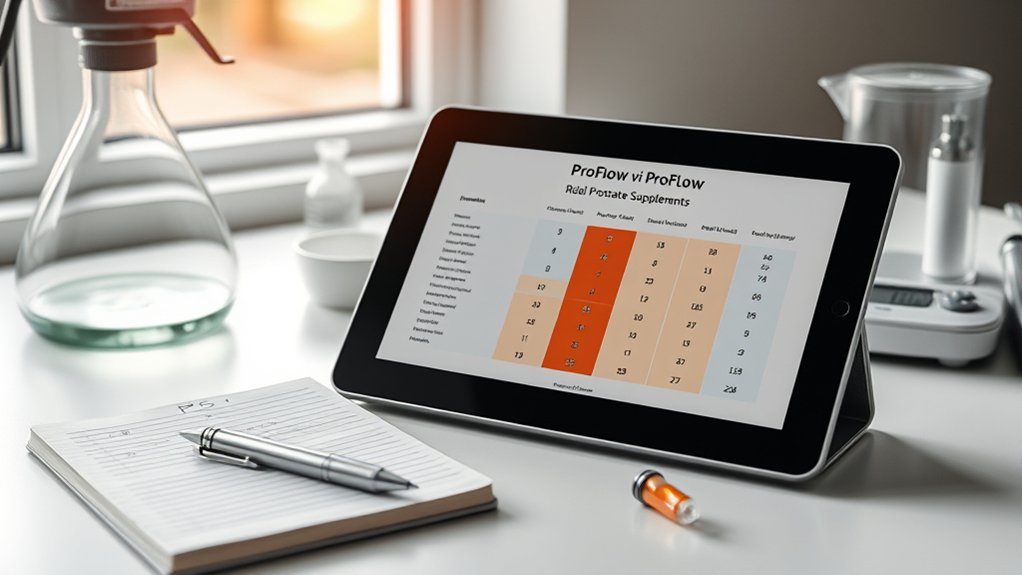
When you compare ProFlow to other prostate supplements, you’re looking for evidence-aligned differences in formulation and dose, not just label claims. ProFlow’s unique herbal blend synergy is positioned to target prostate-relevant pathways, and its targeted support claims should be evaluated against competitor ingredient panels, standardization, and available human data. Use a methodology-first comparison—verify standardized actives, dosing per serving, and study quality—so you can see what truly sets ProFlow apart.
Unique Herbal Blend Synergy
ProFlow’s differentiator is its unique herbal blend synergy—formulated so multiple standardized extracts can work on complementary biological pathways implicated in prostate health, rather than relying on a single “active” ingredient. You should look for a design that anticipates compound interactions, because herbal synergy can modulate signaling, oxidative balance, and inflammatory mediators via coordinated mechanisms. In your evaluation, focus on methodology: standardized extract sourcing, quantified phytochemical markers, and dose consistency across manufacturing lots.
- Multiple standardized extracts, each with defined actives
- Evidence-aligned rationale for herbal synergy and pathway coverage
- Harmonized dosing to reduce “single-hit” variability
- Controlled formulation to support predictable compound interactions
If you’re comparing labels, prioritize compositional transparency over proprietary claims, and confirm consistent extract strength through batch testing.
Targeted Prostate Support Claims
How do ProFlow’s targeted prostate support claims compare with those you’ll see on other supplements? You should compare claim language to study endpoints, not marketing intensity. ProFlow’s positioning centers on prostate health, so you’d look for evidence tied to measurable outcomes like urinary symptom scores, prostate volume proxies, or relevant biomarkers. Methodologically, pay attention to whether claims are derived from ingredient-specific human data, dose–response relationships, and clinically meaningful effect sizes rather than preclinical signals. Many competitors make broader “men’s health” promises without specifying protocols, study duration, or statistical thresholds—weakening supplement efficacy interpretability. If ProFlow cites structured evidence, you can evaluate consistency across populations, adherence rates, and comparator designs. Ultimately, you’ll trust claims only when they map to validated clinical endpoints.
Formulation Versus Competitors Differences
Across prostate supplements, what matters most isn’t the loudest “men’s support” language—it’s whether the formula is built around ingredient-level evidence that matches the outcomes you’d measure in a clinic. When you compare ProFlow’s formulation to competitors, focus on ingredient sourcing, standardization, and dose transparency, not marketing blends. Many alternatives rely on under-specified “proprietary” extracts, making it hard to verify bioactive amounts or link them to endpoints like symptom score change or DHT-related biomarkers. ProFlow’s formulation comparison shows a tighter methodology: each key ingredient is selected for mechanistic plausibility, backed by published data, then paired in a dosing scheme designed to support consistency across batches.
- Clear extract identity and standardization targets
- Evidence-linked dosing aligned with measurable endpoints
- Traceable ingredient sourcing and quality controls
- Reduced variability vs proprietary blend alternatives
ProFlow Quality Check: Sourcing, Manufacturing, and Third-Party Testing
Sourcing and manufacturing controls determine whether ProFlow is consistent across lots, so you should verify the supply chain by reviewing declared raw-material sources, quality certifications, and traceability documentation. Focus on the company’s sourcing practices and how they document supplier qualification, COAs, and batch genealogy to support identity and purity. Next, confirm manufacturing standards: look for current Good Manufacturing Practices (cGMP), validated cleaning/contamination controls, batch records, and defined in-process testing (e.g., blend uniformity). For clinical plausibility, require third-party testing reports for each lot and evaluate which assays were used (identity, potency, microbial burden, heavy metals, and contaminants). Finally, check that certificates match the production lot number and are independently issued, not internal summaries.
How to Take ProFlow Prostate Formula for Best Results
To get the most reliable results from ProFlow Prostate Formula, you’ll want to follow a standardized dosing method tied to the label’s directions and keep your intake consistent day to day—because many clinical outcomes depend on adherence and steady exposure, not “timing tricks.” Use the same dosage timing each day, and don’t stack extra doses if you miss one; instead resume normal use. If you have any conditions or take other therapies, confirm compatibility with your clinician.
- Take with water, using the label’s serving size.
- Maintain consistent dosage timing (e.g., morning or evening).
- Consider administration tips like pairing with a regular meal if tolerated.
- Track adherence for a methodical baseline before judging effects.
What to Expect in the First 30–90 Days on ProFlow
In the first 30–90 days on ProFlow Prostate Formula, you should expect effects—if they happen—to emerge gradually rather than overnight, because the formula is designed to support prostate health through consistent daily intake and bioactive absorption. For your initial expectations, use a pre-planned monitoring approach: track urinary symptom frequency, nocturia, and perceived flow quality at baseline, then reassess weekly. Many users report early improvements during weeks 4–8, but the pattern should be interpreted cautiously, since placebo and regression to the mean can influence subjective ratings. Methodologically, keep dose timing consistent, avoid stacking multiple new supplements, and note adherence. If objective measures don’t shift by day 90, you can’t conclude inefficacy without confirming adherence and confounders.
Potential Red Flags With ProFlow: Allergens, Contraindications, and Interactions
Even if you’re tracking urinary symptoms over the first 30–90 days, ProFlow Prostate Formula still has potential safety variables—so you’ll want to review allergens, contraindications, and interaction risk upfront rather than waiting for side effects. For evidence-driven use, you should compare the label against your allergy history, current meds, and relevant contraindication considerations. Then, monitor for adverse signals using a structured symptom log and timing (dose-to-effect windows).
- Allergy awareness: verify every active and excipient for known triggers; discontinue if reactions occur
- Contraindication considerations: check for conditions (e.g., hormone-sensitive issues) or recent surgery/labile health
- Interaction insights: review supplement–drug timing, enzyme effects, and additive bleeding/sedation risks
- Ingredient safety: assess dose range rationale and any proprietary blend transparency limits
Price Vs. Value for ProFlow: Subscription, Servings, and Cost Per Day
Evaluating ProFlow’s price vs. value starts with a straightforward unit-cost method: calculate your total subscription outlay, divide it by the labeled number of servings, and then compare the resulting cost per day to the clinical plausibility of the doses you’re receiving. For evidence-driven cost analysis, you should verify the serving size corresponds to the recommended daily intake, not a per-capsule approximation. Next, map the labeled servings to your expected month length; small label mismatches can shift cost/day meaningfully. With subscription models, track renewal cadence, shipping fees, and any introductory discounts that disappear after the first cycle. Finally, benchmark your cost/day against the ingredient label’s effective dose ranges reported in the literature, looking for whether you’re paying for under-dosed blends or clinically coherent amounts.
Is ProFlow Worth It Overall? Best-Fit Use Cases and Final Takeaways
After you’ve sanity-checked ProFlow’s cost per day against the labeled serving size and the implied daily dose, the next step is deciding whether it’s worth it for you—not just whether it’s “cheap.” In practice, ProFlow tends to make the most sense when you can confirm you’re matching the manufacturer’s intended daily protocol and when your goal aligns with the blend’s documented mechanisms and dosage ranges, rather than using it as a generic wellness supplement.
- Best-fit use: targeted prostate support with clear dosage recommendations and ingredient transparency
- Evidence check: interpret user benefits through consistent user experiences, not testimonials alone
- Cost effectiveness: compare health comparisons versus market alternatives on dose-adjusted cost
- Watch long term effects: track tolerability and outcomes over months, not weeks
Common Questions
Is Proflow Vegan or Suitable for Vegetarian Diets?
ProFlow is generally positioned as vegan and suitable for vegetarian diets, but you should verify the label or certificate of analysis for each batch. From a clinical, methodology-oriented standpoint, check for non-vegetarian inputs like gelatin, fish-derived omega-3s, or shellac in coatings. For dietary considerations, confirm allergen statements and confirm “vegan”/“vegetarian” claims. This helps you realize plant based benefits without unexpected animal-derived ingredients.
Does Proflow Contain Soy, Gluten, or Common Major Allergens?
Yes—check the label: ProFlow may contain soy or gluten only if listed in the Supplement Facts; otherwise, it should be free. For major allergens (milk, egg, fish, shellfish, tree nuts, peanuts, wheat, soy, sesame), rely on manufacturer allergen testing statements and current COAs where available. Evidence-driven review means you verify allergen sourcing/manufacturing controls, confirm cross-contact risk, and match ingredients to “contains” warnings before use.
Can I Take Proflow With Saw Palmetto or Prescription Prostate Medications?
Yes, you can generally take ProFlow with saw palmetto or prostate meds, but you shouldn’t mix blindly—how delightfully risky. An interactions overview should guide you: check for additive effects on androgen pathways, bleeding risk (if on anticoagulants), and blood-pressure changes (if on alpha-blockers). For dosage recommendations, follow ProFlow’s label and your clinician’s prostate-med regimen; separate by 2+ hours if needed. If you’re on finasteride, tamsulosin, or anticoagulants, ask first.
How Soon Can Proflow Be Taken After Surgery or Catheter Removal?
You can generally take ProFlow 24–48 hours after catheter removal, provided you’re stable, not bleeding, and your surgeon okays supplements. For post-surgery recovery, start earlier only if your clinician confirms no active infection, unmanaged pain, or anticoagulant interactions. Evidence for timing is limited—most data on prostate health supplements comes from observational studies and short trials—so use a conservative, individualized approach. Follow dosing on the label and reassess if symptoms worsen.
What’s the Return Policy if Proflow Doesn’T Work for Me?
If ProFlow doesn’t work for you, you can request a refund through the refund process outlined by the provider. You’ll typically start with a purchase verification, then submit a short claim using your order info. Expect the satisfaction guarantee to cover eligible cases, after which the team reviews your usage timeline and product consistency. For the most evidence-driven outcome, keep bottle seals and usage logs. If approved, refunds post back via your original payment method.
Overall
If you decide to try ProFlow for BPH-like urinary discomfort, don’t treat the existing claims as conclusive—because much of the support is based on non-randomized, self-reported data rather than strong placebo-controlled trials. Start with a simple, measurable plan: track your symptom scores (e.g., urinary frequency, urgency, nighttime urination, weak stream) at baseline, then log them consistently over 6–12 weeks while taking the product strictly at the label dose.
Actively monitor your response and safety: note any adverse effects, potential trigger foods/medications, and whether there are any interaction concerns relevant to your health profile. If you’re not seeing a clear, measurable improvement after your tracking period—or if symptoms worsen—reassess your approach with a qualified clinician and don’t “push through” without evidence. Use this trial period as information to guide your next step, not as a guarantee of results.